I had a conversation the other day about what a shame it was that I didn't have many photos of my time as a student, or at school. How we just didn't take them in those days, and if we did, they were often blurred, or we'd lost them. And I started thinking about what a shame it was that digital photos and social media weren't around when I was younger. What a better record I'd have of my life back then. Then I watched this, and I wondered.....
Thursday, 17 September 2015


Wednesday, 16 September 2015
Narrative Goals
Last week I went to the first meeting of a project to look at producing a set of narrative goals about why diversity in our staff is good for us. I've been involved in the University Equality and Diversity Board for many years, and in a project to look at equality objectives for a couple of years. It's really important to understand that this isn't about box ticking, trying to achieve targets, or positive discrimination. It's about recognising that people are diverse, and that diverse teams have been shown to work better together, to solve problems quicker, and achieve higher outputs. It's a real tendency to appoint in our own image - we all like to think we're great at our job, and if only everyone else we're just like us.... Well actually, that's not true. We need different people, from different backgrounds in our teams. And instead of appointing the best person for the job we should often be looking for the best person for the team.
Our department is taking part in a pilot to produce a set of narrative goals (not targets!) to help us work out what sort of teams will help us be the CiCS of the future! What sort of skills and personalities do we need, what have we got, what are we lacking. How should we be recruiting etc. we're in the early stages at the moment, we've had one workshop with Simon Fanshawe and Roy Hutchins, which was a fairly intensive 3 hour sessions with just two of us from ViCS, but certainly made us think!
 Posted with Blogsy
Tuesday, 15 September 2015
Displays and a Peregrine
Last week I went to visit Samsung at their HQ in Chertsey. We're talking to them about some technical help for a future conference. It was a really interesting day. From looking at their consumer products, including tablets, phones and some pretty impressive flat screen TVs in their consumer showroom:

 to talking to them about future teaching and learning technologies. We looked at different display technologies, including interactive touch screens for teaching spaces, and some rather neat touch 3D
 screens - almost Minority Report like! There was also some nice curved monitors, apparently easier on the eye for people who look at screens all day as the peripheral vision is less strained.
I particularly liked an advert they were showing on a lot of their screens - not necessarily anything to do with the product, but it had some rather excellent footage of a Peregrine Falcon!
Monday, 14 September 2015
Where has all the blogging gone....
Well it's been 4 weeks since my last post - the longest blogging break since I started writing this in October 2007 I think. A number of reasons for that. First, I took a couple of weeks off work in August, one of those was for my annual pilgrimage to Whitby Folk Week, and I know how much some of you look forward to the obligatory morris dancing picture following that, so here it is - the wonderful Seven Champions Molly Dancers, straight from the Frittenden Treacle Mines.

Look at the colour of that sky - it was like that for almost the whole week we were there!
I suppose the second reason for the break, is that I just don't seem to have had a lot of time. I'm spending a lot of time during the day getting out and meeting Heads of Department. I decided I would visit each head over the summer, and I've almost made it, just a few more to do. The other thing taking up time, especially in the morning, lunchtimes and evenings, when I often write this, was walking. Back at the beginning of the summer, a stalwart walker in the department suggested that we enter a team in the Global Corporate Challenge, so I volunteered. Seven of us formed the Trekking Techies of CiCS, and set out to see how far we could walk in 100 days. I was used to walking between 10,000 to 12,000 steps a day, and originally set myself a new target of 13,000, but to keep pace with the others, and with other teams, I soon upped that to 16,000 and in the last 40 days did 18,000 a day. When you get all your steps from walking, I don't cycle or run, this can take up a lot of time! Many evenings I got home from work and then went for a long work to get my steps up. But it paid off, and we came third out of 75 teams entered by the University, and depending on when you took a snapshot of the final results, we came about 780 out of 42,000 teams worldwide. A very respectable result. So, thanks to George, Dave, Andy, Steve, Jenny, Tessa for being great walking companions.
So now I'll get back to blogging and telling you what I've been up to. I'll try and post a couple of catch up posts in the next couple of days to get up to date.

Look at the colour of that sky - it was like that for almost the whole week we were there!
I suppose the second reason for the break, is that I just don't seem to have had a lot of time. I'm spending a lot of time during the day getting out and meeting Heads of Department. I decided I would visit each head over the summer, and I've almost made it, just a few more to do. The other thing taking up time, especially in the morning, lunchtimes and evenings, when I often write this, was walking. Back at the beginning of the summer, a stalwart walker in the department suggested that we enter a team in the Global Corporate Challenge, so I volunteered. Seven of us formed the Trekking Techies of CiCS, and set out to see how far we could walk in 100 days. I was used to walking between 10,000 to 12,000 steps a day, and originally set myself a new target of 13,000, but to keep pace with the others, and with other teams, I soon upped that to 16,000 and in the last 40 days did 18,000 a day. When you get all your steps from walking, I don't cycle or run, this can take up a lot of time! Many evenings I got home from work and then went for a long work to get my steps up. But it paid off, and we came third out of 75 teams entered by the University, and depending on when you took a snapshot of the final results, we came about 780 out of 42,000 teams worldwide. A very respectable result. So, thanks to George, Dave, Andy, Steve, Jenny, Tessa for being great walking companions.
So now I'll get back to blogging and telling you what I've been up to. I'll try and post a couple of catch up posts in the next couple of days to get up to date.
Friday, 14 August 2015
Clearing
Really important day yesterday - confirmation and clearing. The day prospective students get their A level results and find out of they've got a place at their chosen University, or a place at all. If they haven't they go into clearing (and adjustment, which is relatively new). Like many Universities we set up a call centre in one of our IT spaces to handle the calls.

All extremely professionally done, a real team effort between the Admissions team, CiCS and Epigenysis.
One of the main impacts on us is the phone system, but our new monitoring system helps us manage that.

Of course, refreshments have to be provided, and my only real job today is to take them donuts, cookies, fruit and cheese.

I know my place :-)

All extremely professionally done, a real team effort between the Admissions team, CiCS and Epigenysis.
One of the main impacts on us is the phone system, but our new monitoring system helps us manage that.

Of course, refreshments have to be provided, and my only real job today is to take them donuts, cookies, fruit and cheese.

Thursday, 13 August 2015
Diamond progess
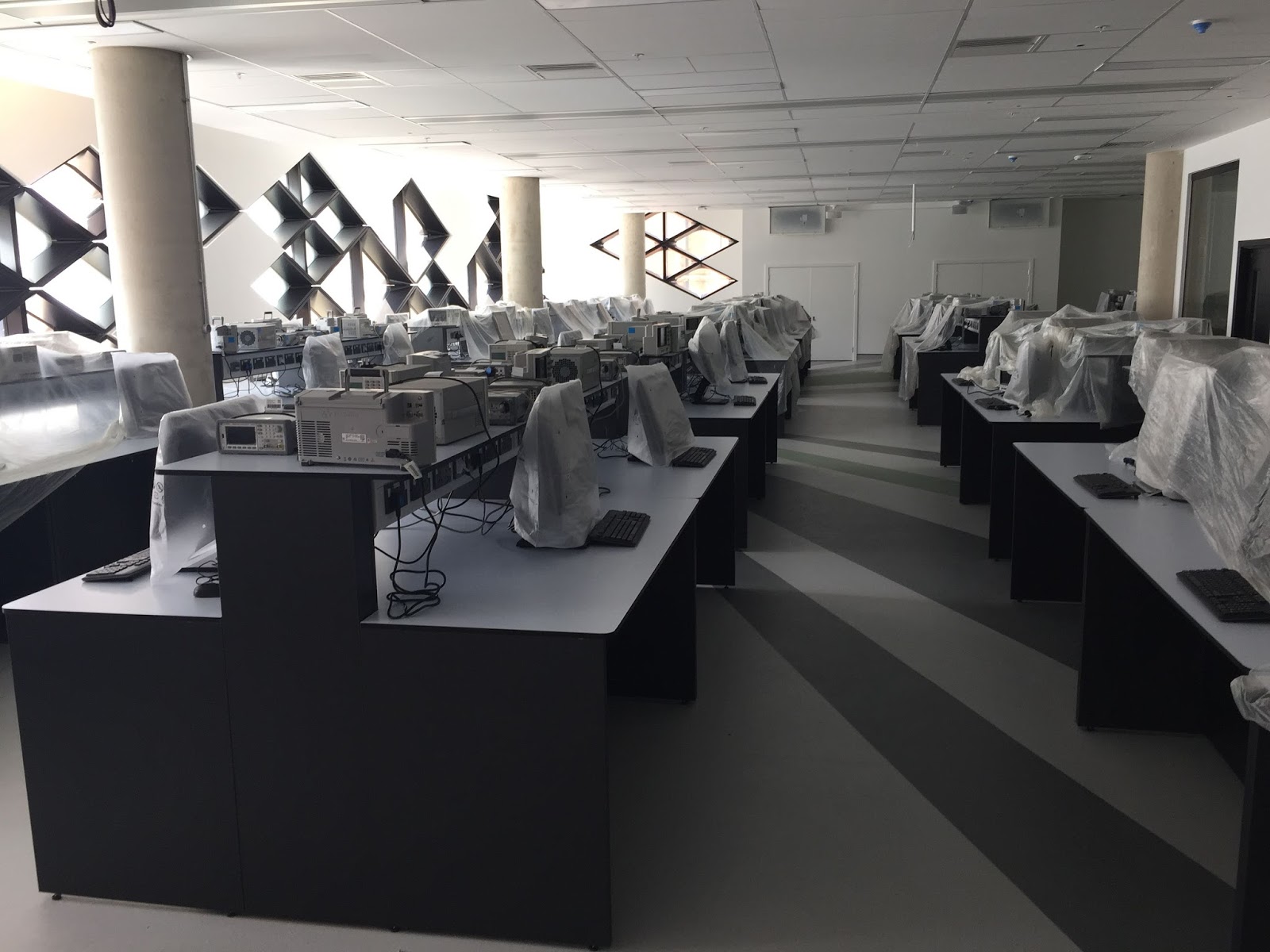
I was lucky enough to be shown round The Diamond again yesterday - it's really looking stunning now, and coming along well. We're in there sorting networks out and installings and imaging PCs.
The team are doing a great job, theres a lot of hardware to get in - look at this plan of just one floor and what we're installing.

Took some pictures, but thought I'd share some facts and figures with you first, which CiCS colleagues will recognise from an excellent presentation at a recent departmental meeting. As well as purpose built state of the art engineering labs, there'll be the following spaces we have an interest in:
9 Lecture Theatres - Seating up to 1680 students
4 Flexible Teaching Spaces - Seating up to 388 students
3 IT Lab Facilities - Seating up to 252 students
9 Open Plan/Silent Study Areas - Seating up to 513 students
9 Group Study Rooms - Seating up to 73 students
10 Breakout Rooms - Seating up to 90 people
Virtual Reality Lab & Flight Simulator
Creative Media Facilities including:
8 Media Booths
TV Studio
Large Media Editing Suite
Small Media Editing Suite
Large Range of Loanable Recording Equipment
Open 24/7 with staff support 9-5
Quite a range of incredible spaces! There'll be 20 data cabinets in it, over 3.500 data outlets and nearly 200 wireless access points.
So - the latest pictures;
View across the atrium to the spiral staircase and one of the pods

One of our study areas


Looking over a pod to St George's Church

One of the computer rooms showing the installed PCs

..and the number of boxes we have to get rid of

The team are doing a great job, theres a lot of hardware to get in - look at this plan of just one floor and what we're installing.

Took some pictures, but thought I'd share some facts and figures with you first, which CiCS colleagues will recognise from an excellent presentation at a recent departmental meeting. As well as purpose built state of the art engineering labs, there'll be the following spaces we have an interest in:
9 Lecture Theatres - Seating up to 1680 students
4 Flexible Teaching Spaces - Seating up to 388 students
3 IT Lab Facilities - Seating up to 252 students
9 Open Plan/Silent Study Areas - Seating up to 513 students
9 Group Study Rooms - Seating up to 73 students
10 Breakout Rooms - Seating up to 90 people
Virtual Reality Lab & Flight Simulator
Creative Media Facilities including:
8 Media Booths
TV Studio
Large Media Editing Suite
Small Media Editing Suite
Large Range of Loanable Recording Equipment
Open 24/7 with staff support 9-5
Quite a range of incredible spaces! There'll be 20 data cabinets in it, over 3.500 data outlets and nearly 200 wireless access points.
So - the latest pictures;
View across the atrium to the spiral staircase and one of the pods

One of our study areas

The Electronics Lab
Looking over a pod to St George's Church

One of the computer rooms showing the installed PCs

..and the number of boxes we have to get rid of

Wednesday, 12 August 2015
Prioritisation and a joker
We had a SSB this week - Service Strategy Board, and high on the agenda was how we prioritise projects. What factors to take into account, what is the relative priority of our existing projects, and where do new ones fit. A lot of preliminary work has already been done, and we have a priority list already - based on a number of criteria, including whether something is statutory or strategic, and what is its reach and impact. Whether they are the right criteria is of course still up for discussion. I'd like to see more account taken of innovation and improving the user experience, but there is still some more work to do. I was amused to see that there was the provision for a wildcard, or joker, which I was told I could only use once ;-) We also looked at the large pieces of work we do in the department that aren't classed as projects, and how we prioritise them. Perhaps the first question might be, why aren't they classed as projects? In some organisations any piece of work that takes more than a certain number of days is classed as a project. This work is linked to discussions that have been taking place on how we handle the workload in the development team and how that is prioritised.
Then yesterday we had a internal discussion following the workshop a couple of weeks ago on Digital Transformation, and how some of the work we want to do in this area sits with the priorities work. Given that what we want to do by setting up some sort of Digital and Innovation team is work in a Mode 2 way (if you're talking Biomodal working), does this sit completely outside this work? We also looked at some of the work that we might do under the umbrella "Digital transformation", and the resources we might need to do it.
All matters for discussion over the coming weeks.
Then yesterday we had a internal discussion following the workshop a couple of weeks ago on Digital Transformation, and how some of the work we want to do in this area sits with the priorities work. Given that what we want to do by setting up some sort of Digital and Innovation team is work in a Mode 2 way (if you're talking Biomodal working), does this sit completely outside this work? We also looked at some of the work that we might do under the umbrella "Digital transformation", and the resources we might need to do it.
All matters for discussion over the coming weeks.
Friday, 7 August 2015
Concepts in concrete
Quick round up of the week - lots of meetings, mainly with heads of departments as I'm trying to get round all of them before the end of the summer. Interesting going into departments, some of which I haven't been to for a long time, or even at all, and I've only got lost once so far. Lots of things to discuss with all of them. Some issues in common with many of them, some more specific to their specialism.
One of the things I've been amazed at, but not sure why I am, is how differently departments do things. We have systems for example for Student Attendance Monitoring (SAM) and Assessments (DAS), but they are used in completely different ways by departments, if they are used at all. Many told me that had invented their own system for doing things, others still relied on old fashioned bits of paper. Something that our new Student System will hopefully address.
One topic that is always interesting is talking to them about research IT support. We have provided support in this area for a long time, but not as much as we should have been doing, and we will be increasing the size of our research IT team considerably over the next two years. This has gone down extremely well with departments who are looking forward to the closer working relationship we will be able to establish with them. In fact, everyone has said how much closer they'd like to work with us which is really positive.
Some departments have given me a tour and talked a lot about the research they do. And in some I've been able to see student work. This is definitely a prompt for us all to get out more into departments and see the great stuff they're doing, and connect with them in a much more local way.
This is in Landscape Architecture, on the 14th floor of the Arts Tower, a fantastic view, and a display of student work, including some interesting concepts of what you can do with concrete!

One of the things I've been amazed at, but not sure why I am, is how differently departments do things. We have systems for example for Student Attendance Monitoring (SAM) and Assessments (DAS), but they are used in completely different ways by departments, if they are used at all. Many told me that had invented their own system for doing things, others still relied on old fashioned bits of paper. Something that our new Student System will hopefully address.
One topic that is always interesting is talking to them about research IT support. We have provided support in this area for a long time, but not as much as we should have been doing, and we will be increasing the size of our research IT team considerably over the next two years. This has gone down extremely well with departments who are looking forward to the closer working relationship we will be able to establish with them. In fact, everyone has said how much closer they'd like to work with us which is really positive.
Some departments have given me a tour and talked a lot about the research they do. And in some I've been able to see student work. This is definitely a prompt for us all to get out more into departments and see the great stuff they're doing, and connect with them in a much more local way.
This is in Landscape Architecture, on the 14th floor of the Arts Tower, a fantastic view, and a display of student work, including some interesting concepts of what you can do with concrete!

Friday, 31 July 2015
Swimming pond, fountains, steps and the darknet...
On Wednesday of this week I went to a RUGIT (Russell Group IT Directors) meeting in London. I got there a bit early, so instead doing what I normally do and having a cup of coffee, I went for a walk. I needed to get my steps in for our Global Corporate Challenge team! I went round the back of St Pancras station,where the area is really being developed. I found a swimming pond, filtered naturally by vegetation, though there weren't many swimmers as it was a bit cold, and dancing fountains outside the University of the Arts Building. After a very early train, it was nice start to the day.


The meeting started with a discussion about our relationship with JISC, the future funding model for JISC, the services it offers, and which ones we use. We also talked about the possibilty of a shared datacentre in the north of England, similar to the one in Slough which a number of London Universities use. We'd be quite interested in being tenants in it, especially if was located in Sheffield :-) We also had a presentation on our Security SIG (special interest group), which raised a number of questions about things like web filtering, and whether we know how much of our internet traffic is using the dark net....
I mentioned earlier that I'd been trying to get my steps up for the Global Corporate Challenge which I've mentioned before. There's a team of seven of us from CiCS taking part in it, about 43,000 teams worldwide, and about 75 from the University. I've upped my daily step minimum from 10,000 to 15,000, and am doing about 17,000 most days. Still not as much as some other members of the team though! Currently we're on day 66 and are third in the University and have virtually walked from Japan to Europe. Here's hoping we continue to do well.


The meeting started with a discussion about our relationship with JISC, the future funding model for JISC, the services it offers, and which ones we use. We also talked about the possibilty of a shared datacentre in the north of England, similar to the one in Slough which a number of London Universities use. We'd be quite interested in being tenants in it, especially if was located in Sheffield :-) We also had a presentation on our Security SIG (special interest group), which raised a number of questions about things like web filtering, and whether we know how much of our internet traffic is using the dark net....
I mentioned earlier that I'd been trying to get my steps up for the Global Corporate Challenge which I've mentioned before. There's a team of seven of us from CiCS taking part in it, about 43,000 teams worldwide, and about 75 from the University. I've upped my daily step minimum from 10,000 to 15,000, and am doing about 17,000 most days. Still not as much as some other members of the team though! Currently we're on day 66 and are third in the University and have virtually walked from Japan to Europe. Here's hoping we continue to do well.
Thursday, 30 July 2015
Internet shaming....
Lots of stuff going on this week, so haven't had a minute to blog, so will just share this with you as I catch my breath. As most of you know, I am a great advocate of social media. I think it can be a great force for good. But, as in all things, it has a dark side, and can be used to cause great harm. Jon Ronson, author of amongst other things Men who Stare at Goats and The Psychopath Test sums up the phenomenon that is internet shaming in this great TED talk. I recommend you watch it before tweeting again.
Friday, 24 July 2015
Risky decisions
Another couple of all day workshops this week. The Executive team (me and the 3 Assistant Directors) took ourselves off to do some work on a couple of important topics. First was Risk. managing risk is extremely important to us - deciding which risks we're prepared to take, which we need to mitigate, and which we can ignore. We need to keep and maintain a risk register, and have risk management plans in place. We've already done a lot of work in the department on this, but this was a chance for us to look at it in some detail. To get a fell for the type and range of risks we need to manage, we each came up with as many different risks as we could think of, using post it notes (of course). The we tried to group them into categories. Won't go into all the details, but the range of risks was very interesting - 'technical"risks were just one category out of about 13 including reputational, political, staffing, regulatory and supplier risks. We also mapped them onto a heat map - plotting impact against probability. Like this, which given the lack of things in the top right implied we were either complacent, or had our calibration wrong.

All fairly standard stuff in risk management terms, but we then used this to start to write a risk strategy, and identify risk management plans.
We spent the second day looking at our decision making process - what sort of decisions we take, where are they taken (and more importantly, where should they be taken), and how we can make the whole thing more transparent. Adopted a similar process and had a brainstorm of the types of decision we take - everything from where to go for the Christmas party to deciding our strategic priorities :-) Used this to categorise them, look at where they are and should be taken, and began to draw up a decision matrix.
More on both of the above later as we develop the ideas and share them with the department.

All fairly standard stuff in risk management terms, but we then used this to start to write a risk strategy, and identify risk management plans.
We spent the second day looking at our decision making process - what sort of decisions we take, where are they taken (and more importantly, where should they be taken), and how we can make the whole thing more transparent. Adopted a similar process and had a brainstorm of the types of decision we take - everything from where to go for the Christmas party to deciding our strategic priorities :-) Used this to categorise them, look at where they are and should be taken, and began to draw up a decision matrix.
More on both of the above later as we develop the ideas and share them with the department.
Tuesday, 21 July 2015
Towards digital transformation
Today I've been in a workshop, helping to develop a vision for our website. Well, that's how it started. What we actually did was come up with plans for digital transformation.
Earlier this year we set up a project to look at reviewing and replacing our content management system (CMS). But, we soon realised that what we actually had to do first is work out exactly what we want our web site to do, what audiences it serves, what we want it to deliver, before we even think about the technology. Today we had a workshop facilitated by Paul Boag, who writes a really good blog on all matters digital, to try and come up with a vision of where we want to go.
We know a University priority this year is "Digital", and one of the the things we were trying to unpick today was what "digital" actually means. At one level its a set of technologies - mobile, web, social media, new players such as digital assistants (eg Siri) - but more importantly it's the way these technologies influence behaviour, culture and user experience.
Some organisations are approaching the challenges and opportunities of digital, by setting up Digital Transformation projects. Actually, I'm loathe to call them projects, as one of the things we discussed was how a project culture can kill digital developments, where the cost of failure is low and the process needs to be a quick build, test, improve. Much like the discussions we been having around bimodal IT.
One of the organisations we looked at is the Government Digital Service who have been leading the digital transformation of government, making public services digital by default, and simpler, clearer and faster to use. They have a Service Design Manual which sets out all of their standards for building digital services.
During the day we looked at our business objectives, our customers of the website and its services, what our tangible deliverables are, and opportunities and threats. We did some hard prioritising, and it was painful taking some things out. But, we got to a stage where we have the outline of a business case for a major digital initiative, including the creation of a digital transformation team.
Won't say more than that for now, as we have a lot of work to do, but I'll leave you with one of the fun things we did where we used our artistic skills to illustrate two views of the future - one where we embrace digital, the other where we don't. Hopefully you might be able to tell which is which, but whether you can interpret them, well that's another story :-0


Earlier this year we set up a project to look at reviewing and replacing our content management system (CMS). But, we soon realised that what we actually had to do first is work out exactly what we want our web site to do, what audiences it serves, what we want it to deliver, before we even think about the technology. Today we had a workshop facilitated by Paul Boag, who writes a really good blog on all matters digital, to try and come up with a vision of where we want to go.
We know a University priority this year is "Digital", and one of the the things we were trying to unpick today was what "digital" actually means. At one level its a set of technologies - mobile, web, social media, new players such as digital assistants (eg Siri) - but more importantly it's the way these technologies influence behaviour, culture and user experience.
Some organisations are approaching the challenges and opportunities of digital, by setting up Digital Transformation projects. Actually, I'm loathe to call them projects, as one of the things we discussed was how a project culture can kill digital developments, where the cost of failure is low and the process needs to be a quick build, test, improve. Much like the discussions we been having around bimodal IT.
One of the organisations we looked at is the Government Digital Service who have been leading the digital transformation of government, making public services digital by default, and simpler, clearer and faster to use. They have a Service Design Manual which sets out all of their standards for building digital services.
During the day we looked at our business objectives, our customers of the website and its services, what our tangible deliverables are, and opportunities and threats. We did some hard prioritising, and it was painful taking some things out. But, we got to a stage where we have the outline of a business case for a major digital initiative, including the creation of a digital transformation team.
Won't say more than that for now, as we have a lot of work to do, but I'll leave you with one of the fun things we did where we used our artistic skills to illustrate two views of the future - one where we embrace digital, the other where we don't. Hopefully you might be able to tell which is which, but whether you can interpret them, well that's another story :-0


Monday, 20 July 2015
Graduation time again
Graduation week again - I love this time of year, especially when the sun is shining. So nice to see our graduands and their families.

We're always heavily involved, we have members of the department who are marshalls and stewards, we sell our great range of quality gifts

and of course we film the event, stream it live, sell DVDs and USB sticks of the ceremony, and our own invention, the handshake video.

Congratulations to everyone graduating this week.

We're always heavily involved, we have members of the department who are marshalls and stewards, we sell our great range of quality gifts

and of course we film the event, stream it live, sell DVDs and USB sticks of the ceremony, and our own invention, the handshake video.

Congratulations to everyone graduating this week.
Subscribe to:
Posts (Atom)