Thursday, 29 November 2007

Bikes, Segways and conquering the Universe

I grew up in North Nottinghamshire, and loved riding my bike. Now I live in Sheffield, I don't even own one. Two obvious reasons - too many cars, and, more to the point, too many hills. I hate cycling up hills. Last year a friend persuaded me to cycle over the Golden Gate Bridge in San Fransisco because he told me that once you got onto the bridge it was all downhill. He lied, and I nearly died. So did he when I'd recovered. I was therefore interested to read an account from one of our Campus Wardens about his experience with an electric bike. Our Campus Wardens do a great job of patrolling the campus, checking on car parks and cars, and generally helping to keep the campus clean and tidy. As those of you from Sheffield will know, the campus is spread out, and has a lot of hills, so they have to cover large areas. If they're responding to an incident, it can take them some time to get there. So, our Room and Parking Services section have been trialling a Powabyke. The report has been excellent, with the warden being able to travel over large parts of the campus quickly and safely, even negotiating some quite steep hills with only moderate pedal assist. The bike also kept its charge well - it plugs into a normal socket, and only appears to need charging every few days. This sounds like something the University should be promoting and I can see many areas where it will provide a quick, energy efficient way of travelling around the campus.

Another device to provide this sort of transport, is the Segway. These have never really taken off over here, but in the US you see them a lot, especially in huge conference centres, where there are large, flat distances to be covered. It can be quite a surprise to see one come whizzing past you. They can get up quite a speed - up to 12mph, and you can carry quite a lot of stuff on them. The police also use them. They work by changing your balance - to move forward, you lean forward; to stop, you lean back. To steer, you lean left or right. They're also very energy efficient. I rather fancy one, but I'm not sure if they'd cope with Sheffield hills. They certainly don't cope with stairs. Reminds me of the Dalek joke......


"Well this certainly buggers our plans to conquer the Universe....."

Wednesday, 28 November 2007

IC Filming

Spent a pleasant couple of hours at lunchtime in the Information Commons with some journalism students who were filming a piece to be broadcast on SteelTV which launches on Friday. This is a TV channel which is being set up by the student newspaper, Steel Press. The piece is going to be on what students think of the IC, 6 months after its opening. I was interviewed and asked a number of questions, including whether many students are in the IC at night and whether it's worth opening for 24 hours. Our view is that it is - at busy times there can be several hundred students in the building overnight, and even when it's quiet, there can be 30 to 40. The quietest time is from 5am to 8am. The 24*7 nature of the building was one of the key demands from students during the design phase of the building. Oh, they were also interested in rumours that students were getting up to "no good" in the group study rooms and the shower!

It will be interesting to see what spin the students put on the piece. If my experience with Steel Press is anything to go by, it might not be all that positive! I don't care what they say - I think it's a fantastic building (I think I may have said that before....), and I still smile when I go in. It's an incredibly satisfying experience to see something grow from an idea, through outline sketches, to detailed drawings and plans and finally to a real building. It really is the result of a partnership - between CiCS and the Library, the Estates department, the project mangers and the consultant team, especially the architects. I'd like to do it again now. Roll on Phase 3...

Tuesday, 27 November 2007

Managed service and liaison

Fairly lengthy posts yesterday, so will keep this short!

Had a meeting to discuss how we might improve our liaison with our customers, particularly with the proposed new Faculty structure. There's a number of different types - strategic, technical, liaison with staff, with students, with academic departments and faculties, and with professional services. Had a good brainstorm about a number of different models, and proposals are being drawn up for further consultation.

The group which considers requests for software to be installed on the managed desktop also met today, and as well as approving software installation requests, discussed a couple of matters of principle. We agreed that we would consider requests from departments to install software previously on departmental machines onto the managed service so that students could make use of the increased opening hours of the Information Commons. We also talked about the best way of supporting students who needed access to particular pieces of software, for example for visually impaired students. This is often difficult to install on the managed service or licence restrictions prohibit it, and we believe that the most appropriate way forward is for students to have the software installed on a laptop provided for them, so that they have access to it at any time.

Monday, 26 November 2007

Exploiting the potential for blogs etc part 3

The Hidden Dangers of Social Networks: You can log-on but you cannot hide
Stuart Lee, University of Oxford

Are Computing Services using Web 2.0 technologies? On OUCS web site - RSS, Blog, Podcasts, so some use. NB - are we using anything?
Quote from Gartner - "Web2.0 disrupts existing models. Web 2.0 communities connect people in ways that many companies hadn't anticipated when they began to develop their online strategies"
Is it really disruptive? Has been around a while. Has it changed what we do?
Gartner again: "Social environments are the wave of the future - companies need to provide interactive services such as blogs, wikis and tagging"'

Impact on central IT services:
Is an increased burden - need to provide education, training. Need staff skilled to do it.
14% of Oxford University email is generated from Facebook.
IT services have to keep up with increased user demands and expectations.
Outsourcing and demands for justifying central services. Academics see top slice as infrastructure tax - have to justify our costs. Questions could be asked - why are we paying computing services to provide something that we could get for free from Facebook, Google etc? This is a problem with Web2.0 we have to face. If it's offering a more cost effective service, should we use it? But, when considering solutions like Google apps have to consider hidden issues, political as well as technical.

JISC Great Expectations survey:
65% of prospective students regularly use social networking sites - only 5% never use them. 27% regularly use blogs, wikis etc.
Oxford have found that 96% of freshers use Facebook.

Concerns:
Legal institutional aspects - should we rewrite our rules/AUPs? Or just use exisiting ones. Oxford experience is that if students are asked to take offensive materail down, they usually do. Are problmes with sites like "ratemyprofessor" -c an get some very rude comments. Anonymous. No way of tracing.

Willingness of people to give away so much information about themselves, ie privacy concerns

Appvertising - (a word which makes you want to reach for your revolver according to Stuart) - commercial companies looking at data collected by apps and using it to target information and adverts

Facebook opens profiles to public.
Is no way to delete your personal data from Facebook. Servers are in US so not governed by UK data protection laws.

Concerns about corporate single sign on user name and passwords being used for social networking sites. University regulations say you can't hand user names and passwords over to any other person. But what about handing it to a third party service? Is this against the regulations? If it is, staff suing Blackberrys could be in trouble...C

Oxford has had some press coverage:
Oxford using Facebook to snoop.
Oxford trying to stop "trashing" ie pelting each other with eggs and flour at end of exams. Uni looked on Facebook for photos, and then fined students - 200 students caught and fined, mainly caught by photos their friends had posted and tagged them in. Best education ever about privacy settings on Facebook. This was their social site - VLE was where work was done. Students didn't realise that these were coming together. Private lives clashing with formal lives.
"Facebook is ephemeral - just a laugh"

Second Life
Oxford have bought an island to play about with. Design competition to build it. But then press got hold of it. "Going virtual"
Concern among academics:
It's a waste of money (but it's only £40 per month for unlimited access!!!)
Damages the Uni reputation - it's a game, it's full of porn. But the whole web is full of porn - do we stop publishing on it?
Who gave you the right to do this? Interesting question - who does decide these things?

Conclusion - Web2.0 is fantastic, but IT services have to step in occasionally and give advice.
Explore provision
Tread carefully - separate fad from future
Educate re privacy
Educate re libel
Educate re copyright
Use the tools yourselves

Above all, it's not disruptive and we should let these tools flourish.

Disruptive Technology and its Implications for University Information Services
David Harrison, University of Cardiff

Talkin about:
Things outside the "service offering"
User centric rather than organisation centric
Issues that transcend organisational boundariesIssues that break traditional security and privacy models


UCISA have produced a discussion document setting out the potential conflict between users who want to do new things and service providers who want to lock down and control everything.

Nothing a user can do with disruptive technologies that is different from their use of traditional technology. The primacy of AUP remains.
But, we need to be prepared to relinquish sole responsibility for IT regulations

Cardiff have developed Safe IT Guidelines in partnership with Student Union.

We work in different realms :
sometimes on our own
sometimes in a way that shields our true identity eg Second Life
sometimes as part of a group, as part of an organisation,
sometimes as a contributor to someone else's work
We work differently and use different language according to the realm we are working in.
Most of us haven't had any training in how to work in the virtual world
Cardiff partnering with IBM
IMB have taken a lead in encouraging employees to blog, and have produced guidelines for blogging, and engaging with the virtual world

Different types of blog:
Personal but not corporate - no need for this to be hosted on corporate systems
Personal or group, work related - collaborative - should be host on corporate intranet
Group internet presence - external collaboration with others - may or may not be hosted corporately. Eg UCISA on Facebook.
Corporate blog for marketing etc. - should be hosted on corporate systems

Summary
Adopt suitable language, style, and identity depending on where you are
Have guidelines on usage and on what type of collaboration tool is best for what purpose - IM, chat rooms, email, blogs, wikis, shared workspaces
Be supportive rather than prevent

Nothing new in web 2.0
Users need protecting from their own foolishness
Institutions should trust staff and students and use existing codes of practice
Embrace and engage
Partnership - be customer centric
Work life balance - some people want separation, some like the blurring.

Exploiting the potential for blogs etc part 2

Case Study 3: Put Yourself Out There
Alison Wildish, Edge Hill University

Edge Hill became a University in 2006. Need to do a lot of awareness raising. People talking about you is best form of advertising/PR.

People are going to talk about you....in pub or on a social networking site. Boundaries becoming blurred - common to mix business/study with pleasure. Students don't switch off from Facebook when they come in to uni. But also same for staff. No-one comes in and leaves their personal lives at home. Regardless of any institutional policy - students and staff will use social networking sites.

Approach from Edge Hill - great! Embrace use of social networking tools. Make it easier. Range of communication channels which they will plug into Facebook, and plug student networking sites into university portal.
Policy/strategy - not to have one, not even for teaching and learning. Use it while we can. Use it as complementary to marketing and to existing communication channels.
Blogs managed on site (wordpress), but can use externally hosted ones as well. Not prescriptive.

Actively building applications to link into Facebook. Student portal information fed into Facebook accounts - students opt into it. Not only way of getting info. Different tools for different preferences.
Are problems. eg, they had a false allegation about member of staff on Facebook including photographs. Not under uni control. Solution - use proper channels. Report group. Acceptable use policy covers use of network and facilities - therefore can talk to students. Remind students about libel and defamation laws.
Keele University - asked students not to express dissatisfaction about institution on social networking sites. Goes against culture of openness being encouraged. Instead should educate individuals about their responsibilities. and how to manage on-line presence. Ironically, Keele have won competition on Facebook for favourite university!
Policy on social networking - very open, accept it, allow it,and actively encourage it.
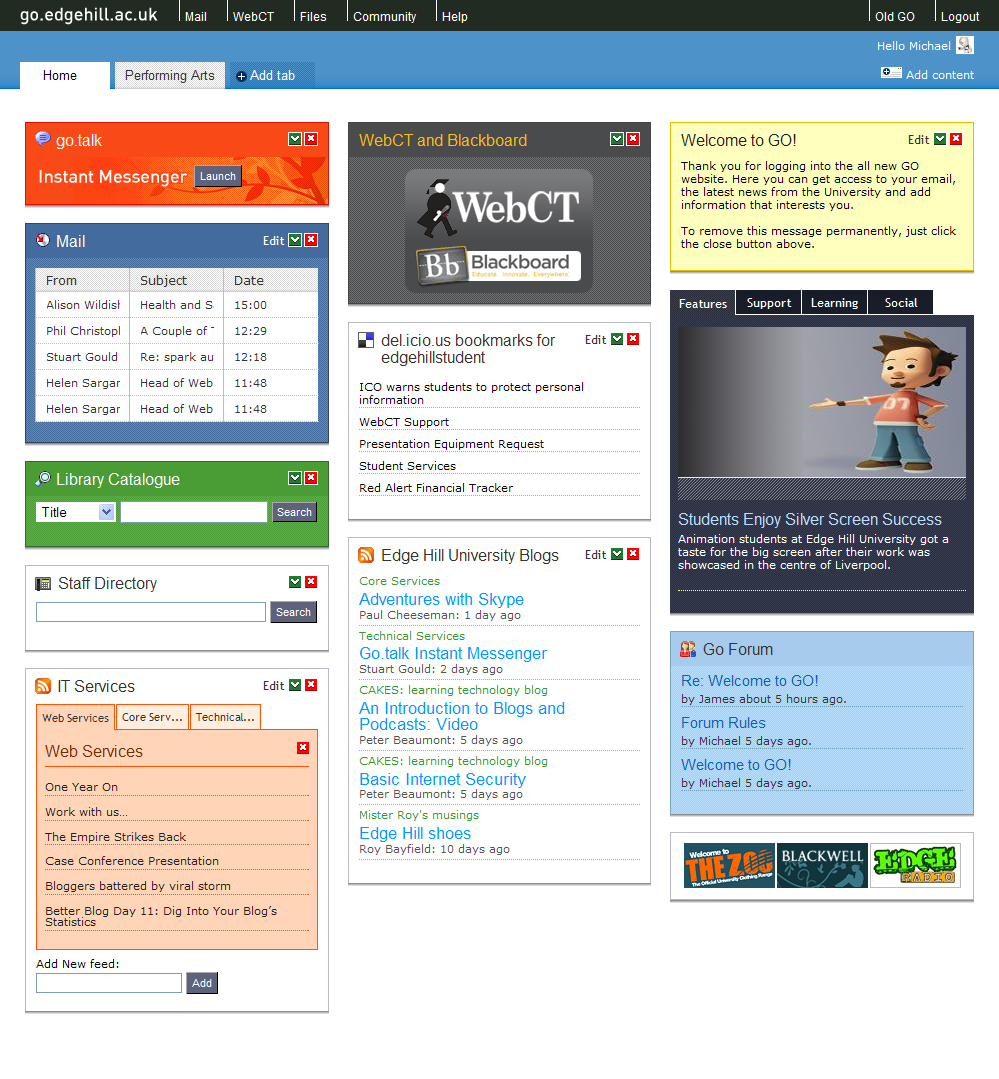
Screenshot of student portal - very Web2.0. Links to YouTube, IM, Flikr, Blogs, news (don't use email).
Some good ideas.
Interesting talk from a University obviously not frightened by social networking and actively embracing it.

Case Study 4: The Student Perspective
Tom Milburn, University of Bath

Tom is a sabbatical officer at Bath, responsible for Education. Has surveyed students to prepare this talk.
Social networks adopted by students at a phenomenal rate - UK are leading social networking users in Europe. Huge potential because of frequency of visits and high retention rates.

Student perspective on social networking:
Peer to peer support
Provides support of their cohert in a strucutred enviroment - eg first years set up group about how to use a lab. Not bound by office hours. Older students coaching younger students. Can ease pressure on staff. Final year student can often explian better than staff. Discussion board can focus on certain aspects of course.

Student feedback
Can provide liaison for staff student committees - have been set up in Bath. Provide open forum - students check regularly (more than email!). Easy to voice opinion, have open channel of communication with staff. Staff can run things past students and gauge opinion.

Mulitmedia
L and t can be enhanced by being offered in various formats. Social networks offer flexible use of images and videos. Questionnaires can be linked to Facebook which can aid research for students projects.

Problems:
Can be perceived as closed commincation channels. ie outside of University
Consequence of actions can become distant as socail networks can be turned off
Need for a username and password can give a false sense of security.
Lack of clarity from University on what the consequence of actions on social ntworks can be.

Advice statements
Uni and SU jointly now providing advice statements
Often details what students should be wary of - be careful about you leave as your digital footprint. If you wouldn't put it on noticeboard, don't put it on the internet.
Privacy - contact details etc. bullying and harrassment
At Bath these were delivered as Flyers on Facebook. Missed the boat, because so many flyers are now advertising, so get lost. Wouldn't do again.

Blogs
Can be excellent ay of keeping students up to date with developments
Not as well known as social networking
But, not easy to find, not updated regulalry, not used by student themselves

Summary
Great potential for social networks to engage students and enhance experience of uni life - email just isn't read
Depends on how much effort staff put in and depends on culture of students on various courses
can be of great value to the instution.

Discussion - more acceptance now of staff using facebook, especially as students see staff having profiles and posting interests etc. Institutions should use the new facility to set up institution pages.


Exploiting the Potential for Blogs and Social Networks

I'll blog during the day, and tidy up later, so apologies for spelling etc.

Introduction from Brian Kelly from UKOLN.

All talks being video streamed, onto a web site and into Second Life. 8 people already in Second Life attending the virtual workshop. Remote participants can log into chat and ask questions. There is a workshop wiki that everyone can contribute to.
Future is Web 2.0. User generated content - big change from standard content management systems at present. Will be challenges for IT departments and universities. Hope to discuss them during day.
Brian gives definition of a blog and uses mine as an example! Thanks Brian.
Then a definition of a Social Network - and uses my Facebook profile as an example. Draws attention to fact that we know what we're posting about ourselves - but do we know what other people are posting about us - embarrassing incidents, photos etc.
What if we build services and no-one uses them - do students want social webs built in institutions? - Recent report from OCLC says that students don't trust institutions with their data, but do trust social networking sites etc.

Case Study 1: Blogging In A Managed Environment
Stephen Clarke, University of Birmingham

Birmingham Uni makes extensive use of blogs - set up in VLE (WebCT Vista), Set up by academic staff as part of course. Not moderated or checked centrally. Academic member of staff responsible for content.

Educational blogs - are there risks?
Innovations are nearly always risky, and risk aversion slows innovation. Risk management needs to be proportionate.
Blogs can be part of VLE. Focussed on learning, assessed, retained by institution.
Can be about work life - more a diary. Help to build cohesion. Can be transient. Independent of learning activities. Is it right for institution to be spending money on this sort of service when resources are available elsewhere?
Blogs can be in social networking software - eg Facebook. Created by students. Can be rude, disrespectful, spread a poor image of University. University cannot easily intervene.
Further risks of using social networking software:
Universal loss of service. Facebook nearly had to go off line a few weeks ago. What if it contained content essential for course?
Individual loss of service - eg individual removed from Facebook, blogger etc. No University control.
Need to agree acceptable level of risk and then manage it.

Good blogs in an educational context:
Secure, safe, reliable
Inappropriate use can be stopped
The institution controls access and sets acceptable use policy
Support institutional goals

Bad blogs:
Are a fact of life
Institutions need to maintain a distance from them
Should not be imposed on learners

Conclusions:
Working in a managed environment:
Supports good blogs
Protects users
Protects content
Carries responsibility

Case Study 2: Leedsfeeds: a Blogging Service based on the Open Source Elgg Application
Melissa Highton, University of Leeds

Leeds host blogs for staff on campus. Many staff stay at Leeds for many years - potentially important resource - research, reflective writing etc. Keeps them safe - Facebook can be for private life only. Protects staff from bullying and harrassment.
Leeds University values:
Community, inclusiveness, integrity, professionalism, academic excellence. All words used when describing Web 2.0!
Leeds did a study on information flows for staff - lot about networking. Networking was very physical - coffee room etc. But in a large organisation, how do you know who knows what, ie who to ask?
Leeds started using an externally hosted product for blogs, but webmaster not happy, so decided to host on campus. Decided on Elgg - free, open source, also allows you to have community blogging, ie not just individual blogs. Also felt that Leeds content should stay on Leeds servers - safe, archiving, being proud of it.
Why should institutions have an interest in blogs and social networks?
Enhance learning. Blogs promoted to staff, can use any way they want to. Can invite students to contribute to community blogs. Haven't had much "trouble", but have had trouble in Facebook. Student know the difference between writing in Leeds Uni domain and on Facebook.
Lot of blogs are public - has led to interest in research, collaboration etc. Students learning to write better because other people reading them.
Community benefits - staff enjoy reading each other's blogs. Groups forming - number of networks being set up as community blogs. Share ideas, put comments and links on each other's blogs. Peer support, reflective learning.

Do users trust it? Seem to.
No moderation, but is a "report as offensive" button. Not used much. Governed by acceptable use policy.
Run training and support for staff. Seen as extension of personal web space.
Not just academic staff - open to all staff. Some librarians and technologists blogging. Is a purchasing community, research office blog, projects news.
Can search by name, tags, see all posts. But fairly chaotic. Some posts private, some public.

Sunday, 25 November 2007

Senate Steering Group reports

I've mentioned in previous posts that the new Vice-Chancellor had identified that a review of the University's organisational structure had a high priority. A Senate Steering Group was established to review the current structure and to make recommendations for change. That group has now produced a report which has just been circulated to Senate and Council for discussion and approval. It has been sent to the CiCS Executive team so that it can be cascaded in the department, so that we can begin to discuss what implications it might have for us and how we organise our services and support.

The key recommendations are:

The existing Faculties (Medicine and Health, Pure Science, Engineering, Arts and Humanities, Social Sciences), are retained and become the primary location for all of the existing 41 planning units and the research centres/institutes;

Each Faculty will be led by a Pro Vice Chancellor (PVC) who will be the budget holders for that Faculty

There will also be 3 PVCs who are appointed to lead cross-cutting areas of research and innovation, learning and teaching, and external affairs

The Senior Management Group (SMG) will be replaced by a University Executive Board (UEB) which comprises the Vice Chancellor and 8 PVCs, the Registrar and Secretary and Director of Finance

The arrangements for the faculty infrastructure, resourcing and operational environment will emerge under the leadership of the new PVCs

The report specifically refers to the scope for alignment of the Faculties with professional services.

I look forward to this being discussed within the departmental teams and will post any further news here as soon as I can.

Tomorrow (Monday) I'm going to a workshop on Exploiting the Potential for Blogs and Social Networking, and providing there is a good wireless connection, will attempt to blog some of the sessions as they happen!

Friday, 23 November 2007

Electronic footprints

I'm interested in a story on the BBC web site about young people and social networking sites - it confirms my belief that we should be giving advice to students about privacy. I'm often surprised by the amount of personal information people post, including contact details, dates of birth, addresses, when they're on holiday. I think most of us would be surprised by the electronic footprint we're leaving. The Information Commissioner's Office has developed a web site for young people which has some good advice. Facebook for example has very good privacy settings, if only people used them.

Edit: When I wrote this, I hadn't seen the front page of today's Independent.

Miscellaneous Thursday

Spent some of today showing a colleague from another Russell Group University around the Information Commons - I still love showing people around the IC - it really is a fantastic facility and we should be proud of it. We then spent a very profitable hour discussing how our respective institutions organise IT services - it's always good to get another perspective, and share experiences - both good and bad. This was particularly useful as we start to think how we might organise ourselves to support a new University structure.

I also got my laptop back today, after its disasterous hard disc crash last week. Great - except there wasn't anything on it when I picked it up. But - looks like all I've lost is the most recent set of photos - still bad, but nothing like as bad as it could have been.

I was interested to see that Amazon have sold out of its book reader - despite some sceptisism about whether anyone would want it. Will the book eventually be replaced? I'm not sure, but I remember not being sure about the fax machine either. Maybe I should do a post about life before the internet, and when cut and paste meant scissors and sellotape. Or maybe that would be showing my age too much...

Wednesday, 21 November 2007

Shared research data

Recently, one of the organisations we're a member of - RUGIT (The Russell Group of IT Directors) has been involved in an Invitation to Tender for a study into the feasibility of establishing a shared digital research data service for UK Universities. This is a joint proposal from RUGIT and CURL (the Consortium of Research Libraries). It’s being funded by HEFCE as part of its Shared Services programme – “shared services” being used to describe a model of providing services in a combined or collaborative way to improve efficiency and reduce costs.

In this case, the outcome could be a business case for a service shared among all UK Universities, with input from the IT departments and Libraries, and bringing huge benefits to researchers.

The amount of data being produced by research is enormous, especially with the advent of grid computing and e-science. Areas such as meteorology, aeronautics and particle physics are obvious producers of large data sets, but all disciplines including the social sciences and the arts and humanities are already producing large volumes of data, of all kinds - complex data used in climate modelling, aerodynamics, molecular modelling, bioinformatics; video and image archives used in archaeology, anthropology and drama; massively large data sets used in particle physics.

The intention is not just to set up a large shared data storage facility - this would be valuable, but would add no real value to the research process. What is being proposed is a facility to manage the whole data life cycle - including creation, selection, retrieval and preservation. This will allow researchers to access previously generated data sets, to undertake new analyses and to annotate existing data.

It’s a very exciting project, and on one which I’ll keep you posted.

Tuesday, 20 November 2007

Exceptional Beer

As well as the work I do in CiCS, I spend a lot of time on other University matters - it's very important to play a wide role and be aware of what's happening in the University. One area I spend a lot of time in is Human Resources - I'm a member of the Pay and Reward Review Group and the Equality and Diversity Board, and I serve on promotion and appeal panels, as well as grievance and disciplinary panels. This afternoon I chaired one of the Exceptional Contribution Award (ECA) panels - after 3 hours preparation of reading and scoring the cases, in 3 hours this afternoon we got through about half of them, so will meet again later in the week to look at the rest. It's hard work, and takes a lot of time, but it's very important that each individual case is considered thoroughly and fairly.

From there I went to a much more enjoyable event - a beer launch! I was lucky enough to be chosen as part of Brewteam 07 - a joint venture between Thornbridge Brewery and the University to produce two new beers to coincide with the opening of The Edge - the new social facility at the Student Village. Two teams of staff and students worked with the brewers from Thornbridge over a period of months to produce the two beers - Belay Bob and Belay Betty. My team produced Belay Bob - by far the more superior of the two - a dark, new world brown ale with lovely coffee overtones, and quite bitter. The two will go on sale soon in outlets around Sheffield - let me know if you see them, and what you think. With a bit of luck I'll be going out to Thornbridge in December to help with the brewing process - I'll see if I can bring some back for the Christmas party.

Monday, 19 November 2007

Executive Team

Several meetings today, and I wasn’t impressed that the last one was at 5pm! I’ll start with the one of most relevance to the department - the Executive Team meeting. Items discussed included:
  • How CiCS might have to realign its services to take account of a major restructuring of the University which will happen next year. I’ll post more on that later when the report is circulated to the Senate.
  • ITIL - this provides a structured framework for best practices for IT Service management and related processes. ITIL has been widely implemented within the IT industry but has only recently been adopted by the HE sector. A number of Universities have started implementing ITIL in specific areas with a view to applying the principles to other areas over time. The areas covered are:
    • Service Strategy
    • Service Design
    • Service Transition
    • Service Operation
    • Continual Service Improvement
Potential benefits of implementing ITIL include improved service quality, better resource allocation and pro-active IT management.
We’ve agreed that in principle we want to implement ITIL but in order to find out more, and decide which bits and how, we’re arranging a half-day overview for key people.
  • Lessons learnt from the power outage incident last week – we’ll be having a number of discussions about how we might improve a number of things.
  • How we might provide training and support for staff in CiCS who manage staff, by setting up a management development programme, tailored to the needs of individual staff

Other meetings included the Admin Team – the Heads and Directors of the Professional Services - where the main item of discussion was the implications of the restructuring, and a meeting to discuss transparency and information flows.

Electronic books

Amazon has just unveiled a wireless electronic bookreader called Kindle. It's about the size of a paperback, holds about 200 books, and is on sale at $400. It doesn't need a PC to download books - you can do it wirelessly.

What does this mean? Other electronic book readers have been released, but have failed to get a big share of the market. Will we ever get used to reading books electronically? Can we get rid of all those books making the Information Commons look untidy and fill it with lovely new PCs instead? Any librarians want to comment?