Monday, 21 September 2015

Knowledge management in a digital workplace

Next session is about managing all of the knowledge and data coming out of smart workplaces.

Knowledge Management (KM) is a discipline to enable effective action through access to relevant intellectual assets, including those that are known, but not documented. It's not a technology. Its biggest challenge is going beyond information into knowledge.

Easy bit is capturing the facts, harder is the implicit stuff, stuff that's in people's heads. Contextual information, experience, expertise etc. Can't capture this, so have to connect people through collaboration systems and capture what makes it possible to act effectively in given situations. Very difficult to capture what everyone knows using conventional methods.

Is it time to automate knowledge extraction? Use AI techniques. Machine learning, linguistic analysis.

For example, fraud detection. Conventional way is to get characteristics of a fraudulent transaction from a human expert and code them up manually in policies, rules or in an automated system. Or, get a machine to look at the history of all relevant transactions. Let it discover common patters and automatically build an automated model to detect fraudulent transactions.

Or Helpdesk. Train agents to deal with problems, talk to each other, capture information in a knowledge base. Or, example from a SAP Helpdesk. take a machine learning system and give it data, software manuals, previous queries, also activity monitoring systems, real time data, data from public sources. Built a service that the user could interact with. Learns form all queries that the system can't deal with and gets passed to an agent, can answer question next time round.

Already using this sort of learning eg in Spam filters.

Will become more prevalent. The digital workplace will increase our ability to observe work. What is being done, by whom, with whom, where,how, at what time, in what context, resulting in what. This will all be observable, recorded and analysed. Will result in either decision support systems, automation,

Example of Boston hospital. All patient records and data in this sort of system. Intended to improve diagnosis, treatment. Decisions still doctors, but this acts a smart assistant.

Use data from previous outcomes to have more data driven approach to support decision making.

Technical challenges:

  • Access to all relevant data
  • Ability to distinguish between positive or negative outcome
  • Existence of historical patters
  • Lack of skills in machine learning
  • Computing resource challenges
  • Still need lot of manual intervention and tuning
  • Spurious correlations, not always a casual relationship

Another big issue - the creepiness factor! Big brother factor. Watching people at work to see if you can automate their job. Have to think about how these techniques are applied.

Expect that by 2017 virtual personal assistants will collect data from applications you are using, will contextualise this. Give you advice and recommendations.

By 2020 will be dominan specific knowledge extraction and reuse systems. Eg HR systems will have built into them analytical tools. Will predict turnover etc.

Need to look at our business activities where we have a lot of data and start to think about automating the extraction of knowledge. Look at areas where we can increase our data collection. Architect, procure and deploy new applications aiming to create feedback loops between automated knowledge extraction and decision support or automation. Talk to our vendors to see where they are going in this area. Identify high priority areas with minimal technical challenges.

Need to track industry responses to cultural, legal, security, compliance and ethical questions.


Interesting session, and some thinking to be done about areas where we might implement some of these ideas. After all, we do have a lot of data! How can we turn this into knowledge?

Digital workplaces

I'm at the Gartner Digital Workplace summit in London for the next couple of days, bit of a last minute booking, as this is a new summit and I hadn't spotted it until recently. Am hoping it ties in nicely with the work on digital strategy we want to start soon. I'll try and take as many notes as I can of the sessions. Will definitely be in note form and not joined up English, so bear with me! I'm also using a new blogging tool on my iPad as my previously one has died, so who knows what posts will look like.

Opening keynote is entitled "Workplace Reimagined, Agile, Empowered, Engaged"

Digital Business is the creation of new business by blurring the digital and physical worlds. Three components people, things and business. Difference to 10 years ago is that the things are smart.

Digital workplace.

Engaged employees are more enthusiastic. By promoting employee engagement digital workplaces create a workforce that makes discretionary contributions to business effectiveness. Has to be based on trust. Building tougher increases trust.

Need to bring consumer like experiences into the workplace. Our most sophisticated computing environment these days is often in our home. Digital workplaces have an explicit goal of creating a consumer like computing experience that enables teams to be more effective. Need to strive for digital dexterity. The things people want to use, will always change. Don't chase the tools. Chase what people want to do.

Use smart technologies and people centric design. Instead of us becoming digitally literate, our computers need to be people literate. Digital workplace strategies exploit rmerging smart technologies and people centric design to support dynamic non routine work. Need to connect people to people, people to things and things to things.

There is no one vendor that will provide what we need. It's like an ecosystem of vendors that we need to stitch together. Need to use lighter weight technologies that will interact. Our teams need specialists who are not technologists. Need to have people who understand people.

IT will be measured in the future by internal customer satisfaction, not by how much money they save!

People need a more natural way of working. The way we interact with computers is improving. Apps that can talk and listen are not new, but apps that can interpret, learn and evolve are. Gartner predict that by 2018 25% of large organisations will have an explicit strategy to make their core computing more consumer like.

Emotion detection, already being used in some call centres. Facial recognition being used in marketing. What might these things mean in workplaces. Teachers with wearable cameras. Really will have eyes in the back of their heads. Workers in dangerous situations such as oil rigs wearing sensors to measure fatigue and stress levels.

HCI will become CHI where the computers are interacting with us.

Access to data, technology and people needs to be universal. Smart machines needed to create contextual experiences. Not talking about AI, ie replicating the way people think, but processing information and feeding it to us in a way we want. Building better tools.

How many people in room use things like Dropbox, when they're not allowed to? Loads. Convenience always trumps security and regulations! Need to change our policies, but also our language.

To really achieve a digital workplace, we need to involve people from outside of IT, eg HR, FM.

People will not only bring their own devices and apps to the workplaces, but will be bringing their own digital assistants. Different ones for different purposes. Amy from x.ai works across time zones to schedule meetings. Amelia from IPsoft handles front line queries and learns from experience. We will be opening up our data eg email and calendars to these digital assistants.

WYNIWYGWYNI great acronym! What you need is what you get when you need it.

Reimagine the workplace. Make it natural, make it universal, make it helpful.


Saturday, 19 September 2015

Students are back......

41 years ago today I arrived in Sheffield. A rather naive 18 year old from a market town in North Nottinghamshire. My Mum and Dad brought me in their car - I think it was a Hillman Minx but I
I could be wrong - dropped me at Halifax Hall, helped me unpack, and left. My room is still there - it's part of a suite in the Halifax Hotel. My room is the living area, and it's been knocked through to the room next door, which was the bedroom of my best friend Jane, who I met on my first night and remained my best friend throughout the three years of my degree. 41 years!!! I can't really believe it was that long ago. I remember it really well. And I've never left. But, the reason for thinking about it, is that today another set of young, apprehensive but excited students arrived in Sheffield.

Today many things are different. We greet them in a very different way. When I turned up, you got your key, were told where your room was, and that was it. Now, we have a fantastic red carpet for new students to walk down to collect their key, as well as a whole set of welcoming stalls and information stands. There's even free ice cream from Our Cow Molly.


And of course, we are there to help students with any IT issues. Mainly how to connect to wifi - which is all they really want. But, we are there to help them with anything. It was a bit quiet when I was there today, but that's a sign we've got thing's right. Everything just works, and they don't really need our help as much as they used to. But, don't this team and our stand look wonderful ;-)


And we'd produced a really good leaflet for students based on the idea of free IT deals...


I had a walk round all of the venues where we had staff today, and spotted something new in the Information Commons - self service laptop hire.


Finally, I'd like to pay tribute to a good friend of mine - Pat McGrath who retires next week - this is her last freshers weekend. She has worked tirelessly over the past 25 years to improve services to students. Today, as usual, hers was often the first face students and their parents saw when they arrived to start this exciting journey. She had a friendly and supportive word to say to everyone, and Freshers' Weekend will not be the same without her.


Friday, 18 September 2015

TELFest and Robots

Today was the final day of TELFest - our week long set of workshops, seminars and drop in sessions to help our academic staff enrich their teaching using technology. Organised by the CiCS TEL team, it's a fantastic event, very well attended, and showcases the best of what's happening here in the TEL world.  This afternoon the two last events were a panel session which I chaired on the future of technology in teaching. We were very lucky to have our new PVC for Learning and Teaching on the panel, and our artistic scribe for the event had prepared a bit of a surprise for him...


After the panel session, we visited "Innovation Corner", a new development where we got some cool bits of technology that were being used across the University to showcases their applications in teaching and learning. We had wearables including Google glass, drones, 3D printers, Oculus Rift and of course robots. There was the cute Nao root, who will be making a star appearance in The Diamond as part of a robot football team


And a very scary robot who uses facial expressions to interact with autisic children. Didn't get a picture of him having a panic attack, but it was really creepy.....


Big thanks to everyone who helped to organise TELFest, who presented sessions, or just attended - it is going from strength to strength and I look forward to the next one.

Sunshine on Leith

Yesterday I was in Edinburgh for a UCISA Executive meeting. It's a lovely place, but a long way to go on the train - just under 4 hours each way. Still, the journey is one my favourites in the UK - past Durham Cathedral, the Angel of the North, Alnmouth, Berwick on Tweed, and the wonderful bit where the train runs so close to the sea. And I do get lots of work done on the journey. Had to go up the night before, and stayed in Leith, because Edinburgh was full!

I only know Leith because it's where the movie Trainspotting is set (despite in being filmed mainly in Glasgow), but it was very different to how I envisaged it. This was my view on a quick walk before breakfast this morning.


We had the meeting in the Edinburgh School of Art Boardroom - definitely a room with a view, and apparently a location for a number of movies! This is not a good picture, but might give a flavour of what it was like overlooking Edinburgh Castle!


One of the main items on the agenda today was how we present ourselves to our stakeholders. We have a website of course, and a lot of publications, and we put on loads of events. But how discoverable is our content? We have so much content, but you'd have to know what it was and where it was to find it. And we only have one "view' onto our website. No matter who you are, you come in to the same place. Our discussions today were very reminiscent of the ones we're having in Sheffield about our own website.

We also looked at progress on a number of projects, including a toolkit on Designing Learning Spaces. UCISA's toolkits are a great resource for the sector. Recent ones include one on Major Project Assurance, and one on Information Security Management.


Thursday, 17 September 2015

If "digital" had been around when I was a teenager

I had a conversation the other day about what a shame it was that I didn't have many photos of my time as a student, or at school. How we just didn't take them in those days, and if we did, they were often blurred, or we'd lost them. And I started thinking about what a shame it was that digital photos and social media weren't around when I was younger. What a better record I'd have of my life back then. Then I watched this, and I wondered.....


Wednesday, 16 September 2015

Narrative Goals


Last week I went to the first meeting of a project to look at producing a set of narrative goals about why diversity in our staff is good for us. I've been involved in the University Equality and Diversity Board for many years, and in a project to look at equality objectives for a couple of years. It's really important to understand that this isn't about box ticking, trying to achieve targets, or positive discrimination. It's about recognising that people are diverse, and that diverse teams have been shown to work better together, to solve problems quicker, and achieve higher outputs. It's a real tendency to appoint in our own image - we all like to think we're great at our job, and if only everyone else we're just like us.... Well actually, that's not true. We need different people, from different backgrounds in our teams. And instead of appointing the best person for the job we should often be looking for the best person for the team.

Our department is taking part in a pilot to produce a set of narrative goals (not targets!) to help us work out what sort of teams will help us be the CiCS of the future! What sort of skills and personalities do we need, what have we got, what are we lacking. How should we be recruiting etc. we're in the early stages at the moment, we've had one workshop with Simon Fanshawe and Roy Hutchins, which was a fairly intensive 3 hour sessions with just two of us from ViCS, but certainly made us think!


Tuesday, 15 September 2015

Displays and a Peregrine


Last week I went to visit Samsung at their HQ in Chertsey. We're talking to them about some technical help for a future conference. It was a really interesting day. From looking at their consumer products, including tablets, phones and some pretty impressive flat screen TVs in their consumer showroom:


to talking to them about future teaching and learning technologies. We looked at different display technologies, including interactive touch screens for teaching spaces, and some rather neat touch 3D
screens - almost Minority Report like! There was also some nice curved monitors, apparently easier on the eye for people who look at screens all day as the peripheral vision is less strained.
I particularly liked an advert they were showing on a lot of their screens - not necessarily anything to do with the product, but it had some rather excellent footage of a Peregrine Falcon!


Monday, 14 September 2015

Where has all the blogging gone....

Well it's been 4 weeks since my last post - the longest blogging break since I started writing this in October 2007 I think. A number of reasons for that. First, I took a couple of weeks off work in August, one of those was for my annual pilgrimage to Whitby Folk Week, and I know how much some of you look forward to the obligatory morris dancing picture following that, so here it is - the wonderful Seven Champions Molly Dancers, straight from the Frittenden Treacle Mines.


Look at the colour of that sky - it was like that for almost the whole week we were there!

I suppose the second reason for the break, is that I just don't seem to have had a lot of time. I'm spending a lot of time during the day getting out and meeting Heads of Department. I decided I would visit each head over the summer, and I've almost made it, just a few more to do. The other thing taking up time, especially in the morning, lunchtimes and evenings, when I often write this, was walking. Back at the beginning of the summer, a stalwart walker in the department suggested that we enter a team in the Global Corporate Challenge, so I volunteered. Seven of us formed the Trekking Techies of CiCS, and set out to see how far we could walk in 100 days. I was used to walking between 10,000 to 12,000 steps a day, and originally set myself a new target of 13,000, but to keep pace with the others, and with other teams, I soon upped that to 16,000 and in the last 40 days did 18,000 a day.  When you get all your steps from walking, I don't cycle or run, this can take up a lot of time! Many evenings I got home from work and then went for a long work to get my steps up. But it paid off, and we came third out of 75 teams entered by the University, and depending on when you took a snapshot of the final results, we came about 780 out of 42,000 teams worldwide. A very respectable result. So, thanks to George, Dave, Andy, Steve, Jenny, Tessa for being great walking companions.

So now I'll get back to blogging and telling you what I've been up to. I'll try and post a couple of catch up posts in the next couple of days to get up to date.


Friday, 14 August 2015

Clearing

Really important day yesterday - confirmation and clearing. The day prospective students get their A level results and find out of they've got a place at their chosen University, or a place at all. If they haven't they go into clearing (and adjustment, which is relatively new). Like many Universities we set up a call centre in one of our IT spaces to handle the calls.


All extremely professionally done, a real team effort between the Admissions team, CiCS and Epigenysis.

One of the main impacts on us is the phone system, but our new monitoring system helps us manage that.


Of course, refreshments have to be provided, and my only real job today is to take them donuts, cookies, fruit and cheese.


I know my place :-)

Thursday, 13 August 2015

Diamond progess

I was lucky enough to be shown round The Diamond again yesterday - it's really looking stunning now, and coming along well. We're in there sorting networks out and installings and imaging PCs.

The team are doing a great job, theres a lot of hardware to get in - look at this plan of just one floor and what we're installing.


Took some pictures, but thought I'd share some facts and figures with you first, which CiCS colleagues will recognise from an excellent presentation at a recent departmental meeting. As well as purpose built state of the art engineering labs, there'll be the following spaces we have an interest in:

9 Lecture Theatres - Seating up to 1680 students
4 Flexible Teaching Spaces - Seating up to 388 students
3 IT Lab Facilities - Seating up to 252 students

9 Open Plan/Silent Study Areas - Seating up to 513 students
9 Group Study Rooms - Seating up to 73 students
10 Breakout Rooms - Seating up to 90 people
Virtual Reality Lab & Flight Simulator

Creative Media Facilities including:
  8 Media Booths
  TV Studio
  Large Media Editing Suite
  Small Media Editing Suite
  Large Range of Loanable Recording Equipment
  Open  24/7 with staff support 9-5

Quite a range of incredible spaces!  There'll be 20 data cabinets in it, over 3.500 data outlets and nearly 200 wireless access points.

So - the latest pictures;

View across the atrium to the spiral staircase and one of the pods


One of our study areas


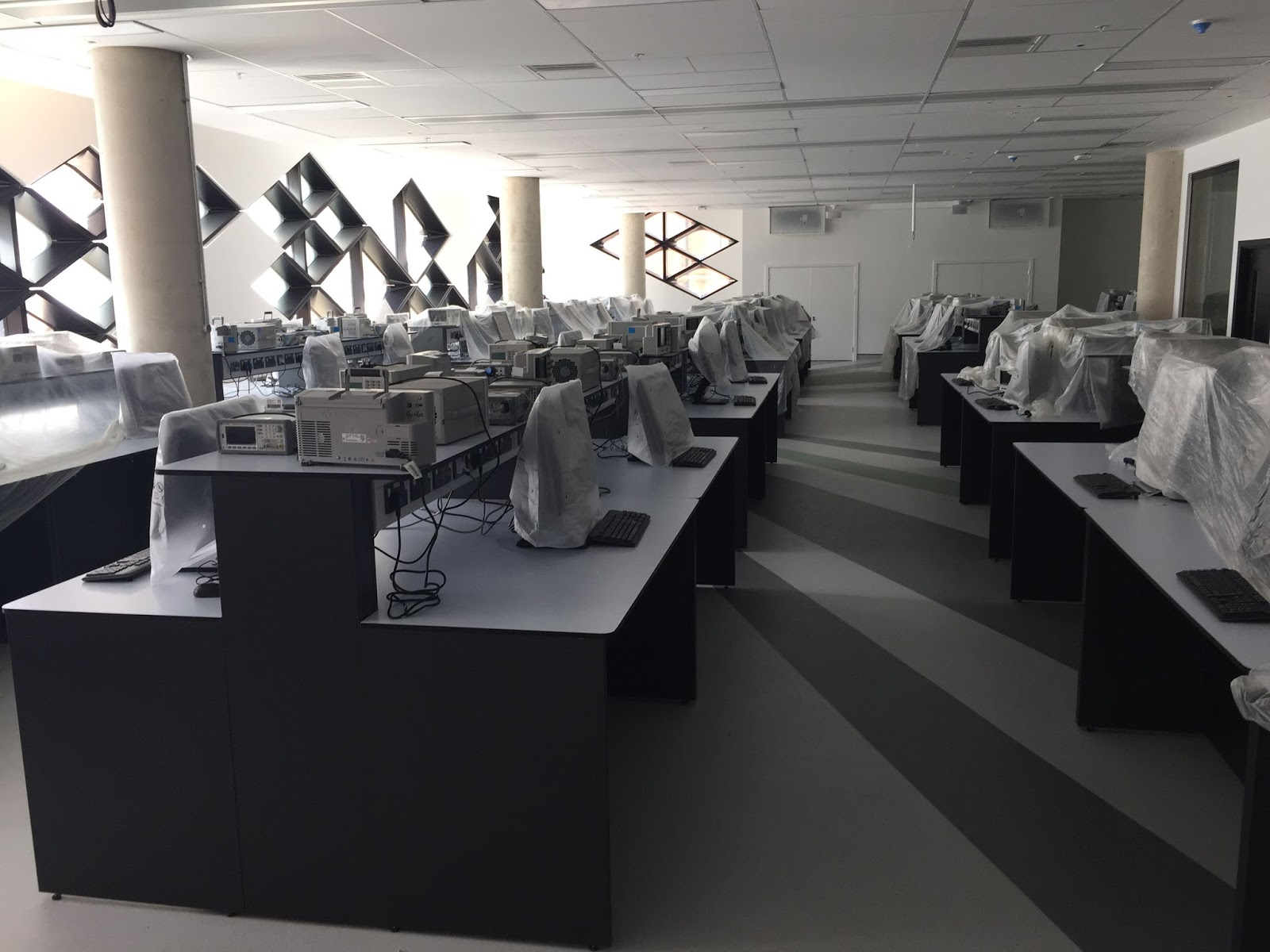
The Electronics Lab


Looking over a pod to St George's Church


One of the computer rooms showing the installed PCs


..and the number of boxes we have to get rid of


Wednesday, 12 August 2015

Prioritisation and a joker

We had a SSB this week - Service Strategy Board, and high on the agenda was how we prioritise projects. What factors to take into account, what is the relative priority of our existing projects, and where do new ones fit. A lot of preliminary work has already been done, and we have a priority list already - based on a number of criteria, including whether something is statutory or strategic, and what is its reach and impact. Whether they are the right criteria is of course still up for discussion. I'd like to see more account taken of innovation and improving the user experience,  but there is still some more work to do.  I was amused to see that there was the provision for a wildcard, or joker, which I was told I could only use once ;-)  We also looked at the large pieces of work we do in the department that aren't classed as projects, and how we prioritise them. Perhaps the first question might be, why aren't they classed as projects? In some organisations any piece of work that takes more than a certain number of days is classed as a project. This work is linked to discussions that have been taking place on how we handle the workload in the development team and how that is prioritised.

Then yesterday we had a internal discussion following the workshop a couple of weeks ago on Digital Transformation, and how some of the work we want to do in this area sits with the priorities work. Given that what we want to do by setting up some sort of Digital and Innovation team is work in a Mode 2 way (if you're talking Biomodal working), does this sit completely outside this work?  We also looked at some of the work that we might do under the umbrella "Digital transformation", and the resources we might need to do it.

All matters for discussion over the coming weeks.

Friday, 7 August 2015

Concepts in concrete

Quick round up of the week - lots of meetings, mainly with heads of departments as I'm trying to get round all of them before the end of the summer.  Interesting going into departments, some of which I haven't been to for a long time, or even at all, and I've only got lost once so far.  Lots of things to discuss with all of them. Some issues in common with many of them, some more specific to their specialism.

One of the things I've been amazed at, but not sure why I am, is how differently departments do things. We have systems for example for Student  Attendance Monitoring (SAM) and Assessments (DAS), but they are used in completely different ways by departments, if they are used at all. Many told me that had invented their own system for doing things, others still relied on old fashioned bits of paper. Something that our new Student System will hopefully address.

One topic that is always interesting is talking to them about research IT support. We have provided support in this area for a long time, but not as much as we should have been doing, and we will be increasing the size of our research IT team considerably over the next two years. This has gone down extremely well with departments who are looking forward to the closer working relationship we will be able to establish with them. In fact, everyone has said how much closer they'd like to work with us which is really positive.

Some departments have given me a tour and talked a lot about the research they do. And in some I've been able to see student work. This is definitely a prompt for us all to get out more into departments and see the great stuff they're doing, and connect with them in a much more local way.

This is in Landscape Architecture, on the 14th floor of the Arts Tower, a fantastic view, and a display of student work, including some interesting concepts of what you can do with concrete!