Just a quick note to say that all of the videos from UCISA15 we are allowed to publish are now up on the UCISA YouTube Channel.
Some you might be particularly interested in are:
Mary Curnock Cook from UCAS and her opening keynote - some really interesting stuff about demographics
Michael Wignall from Microsoft talking about when Digital Life meets Digital Work
Emer Coleman talking about "When excellence is Just a Click away"
And if you really want to see me and Tim Kidd in action talking about when networks go bad, it's here! And as always, some artistic licence may have been taken in places....
But I would recommend you have a look as there are other excellent ones there.
Showing posts with label ucisa15. Show all posts
Showing posts with label ucisa15. Show all posts
Thursday, 2 April 2015


Monday, 23 March 2015
Final round up
A final round up about UCISA2015.

It was really enjoyable, with some great speakers and exhibitors, but I hadn't realised how tiring it would be as chair of the conference committee. Hat's off to everyone who's done it before me!
We had some good social events, and one of the perks of being chair is that you get to be part of arranging them We took a very plain room and turned it into a gothic/spooky themed event for the informal dinner, and the main formal dinner was in the wonderful surroundings of the museum of Scotland. Not a brilliant picture below, but it was a spectacular space.

The other perk is that you gt to meet and sit next to the after dinner
speaker. In this case the very lively and entertaining Gyles Brandreth! He was still tweeting about the stories we discussed into the weekend!


The only session I haven't actually written about, was one I helped to give. Together with Tim Kidd from JISC technologies we did a case study on the outage we suffered back in October, where the whole of the Yorkshire and Humberside region lost connection to the internet for just over 3 hours. We presented it as a lessons learned study, and both sides had some serious lessons to learn, especially around communication. Hopefully there'll be a link to a recording of it up soon, so I might just share it!
Only a couple of weeks to recover, and then we start planning for next years UCISA in Manchester!
- Posted using BlogPress from my iPad

It was really enjoyable, with some great speakers and exhibitors, but I hadn't realised how tiring it would be as chair of the conference committee. Hat's off to everyone who's done it before me!
We had some good social events, and one of the perks of being chair is that you get to be part of arranging them We took a very plain room and turned it into a gothic/spooky themed event for the informal dinner, and the main formal dinner was in the wonderful surroundings of the museum of Scotland. Not a brilliant picture below, but it was a spectacular space.


The only session I haven't actually written about, was one I helped to give. Together with Tim Kidd from JISC technologies we did a case study on the outage we suffered back in October, where the whole of the Yorkshire and Humberside region lost connection to the internet for just over 3 hours. We presented it as a lessons learned study, and both sides had some serious lessons to learn, especially around communication. Hopefully there'll be a link to a recording of it up soon, so I might just share it!
Only a couple of weeks to recover, and then we start planning for next years UCISA in Manchester!
- Posted using BlogPress from my iPad
Friday, 20 March 2015
An inspirational morning...
This morning's session was brilliant - 4 excellent speakers, and we started with a solar eclipse! A couple of weeks ago we'd decided to put the start time back, to allow people to watch it, and I've spent the last few days worrying that it would be cloudy and we wouldn't see anything. But, the sun was out - before the moon moved over it of course, and delegates got a great view - through the special glasses of course - don't they look cool!

We had four speakers - the first three talking about future trends and the last truly inspiational. Because of staring late we didn't have a break, but well done to all the delegates, and speakers for sticking with it. I was chairing the session, so wasn't taking notes for this blog, so these are just a few of my thoughts and memories.
The first session was Nick Jones from Gartner talking about trends in mobile technology. He covered the different platforms, operating systems, apis, app development tools etc, and what we should be looking out for. Secure the app and the data, don't try and secure the device was a key point. Watch the consumer space, that's where the innovation is. And we need to up our game in terms of user experience. Think gamification and employ psychologists for really good UX.
Next was Michael Wignall, National Technology Officer for Microsoft UK, who talked about when Digital Life meets Digital work. I think I can best illustrate the world he described by sharing the video he showed. Two different women, one a scientist looking for project work, and one an executive looking for a scientist.
What was really cool about that - all the technology in it is either in beta or in development right now. And no-one logged in to anything!
Third up was LJ Rich, presenter on BBC Click, journalist and musician. Boy was she lively. Her talk was pure "presentational caffeine".

It was a brilliant, manic look at so many different examples of new technologies, especially around the internet of things. Who could forget the device that makes cauliflower taste of chips.
or brain controlled wearable cat ears (I so want a pair....).

Or this water based interface - great for playing games in the bath!
Out final speaker was Baroness Grey-Thomson. Luckily she didn't mind being called Tanni. One of the greatest paralympians ever. Winner of 11 gold medals, holder of over 20 world records, and 6 time winner of the London marathon.

She was truly inspirational. The whole room was engrossed. Very funny, interesting, personable, and some great anecdotes with serious messages. Ejected at the age of ten from a cinema for being a fire risk in her wheelchair, she was taught the most appropriate response by her mother "I have never spontaneously combusted in my life". She told us to always do the best we can, to be nice to people around us, that "technology can help me to make the best contribution I possibly can", and that parking in a disabled space without a blue badge should be a criminal offence! Truly inspiring end to the conference.
We had four speakers - the first three talking about future trends and the last truly inspiational. Because of staring late we didn't have a break, but well done to all the delegates, and speakers for sticking with it. I was chairing the session, so wasn't taking notes for this blog, so these are just a few of my thoughts and memories.
The first session was Nick Jones from Gartner talking about trends in mobile technology. He covered the different platforms, operating systems, apis, app development tools etc, and what we should be looking out for. Secure the app and the data, don't try and secure the device was a key point. Watch the consumer space, that's where the innovation is. And we need to up our game in terms of user experience. Think gamification and employ psychologists for really good UX.
Next was Michael Wignall, National Technology Officer for Microsoft UK, who talked about when Digital Life meets Digital work. I think I can best illustrate the world he described by sharing the video he showed. Two different women, one a scientist looking for project work, and one an executive looking for a scientist.
What was really cool about that - all the technology in it is either in beta or in development right now. And no-one logged in to anything!
Third up was LJ Rich, presenter on BBC Click, journalist and musician. Boy was she lively. Her talk was pure "presentational caffeine".
It was a brilliant, manic look at so many different examples of new technologies, especially around the internet of things. Who could forget the device that makes cauliflower taste of chips.
or brain controlled wearable cat ears (I so want a pair....).
Or this water based interface - great for playing games in the bath!
Out final speaker was Baroness Grey-Thomson. Luckily she didn't mind being called Tanni. One of the greatest paralympians ever. Winner of 11 gold medals, holder of over 20 world records, and 6 time winner of the London marathon.
She was truly inspirational. The whole room was engrossed. Very funny, interesting, personable, and some great anecdotes with serious messages. Ejected at the age of ten from a cinema for being a fire risk in her wheelchair, she was taught the most appropriate response by her mother "I have never spontaneously combusted in my life". She told us to always do the best we can, to be nice to people around us, that "technology can help me to make the best contribution I possibly can", and that parking in a disabled space without a blue badge should be a criminal offence! Truly inspiring end to the conference.
Thursday, 19 March 2015
Cybercrime and cyber criminals
Really pleased to be listening to Charlie McMurdie, cyber security expert. Previously in the police, now an adviser for PWC.
Globally cybercrime costs $ 388bn a years in terms of financial losses and time lost. UK alone lost £408m from 250,000. Cybercrime is now classed as a Tier one threat.
93% of large businesses breached
Attacks by outsiders up 73%
Average cost of incidents was £65k to £115k
No of security incidents round the world rose 48% to 42.8m
70% of UK companies experiences downtime as a result of security incidents
Used to be mainly brute force, but now more subtle. Cyber criminals don't want you know about them. What to stay on your network longer. Much more sophisticated.
Cybercrime rising significantly in Europe. But Europe dominates other regions in detecting security incidents, a 41% jump in 2014.
Lot of intelligence sharing. Working better between agencies and pulling in intelligence from industry partners
Starting to be seen as a business enabler, not just province of IT department. Is now interest at board level.
Universities at particular risk. We have business reputations to maintain. Most of high end R and D is done in Universities. We are potentially more at risk than a traditional business. Students are the new generation, everything is technology enabled, lots of turnover.
Not just interested in stealing research data, but also a threat of contaminating date, either to discredit it, or don't agree with it.
Different sorts of cybercrime.
Nation state or commissioned attacks. hacktivism, cyber terrorism, organised crime.
Cyber criminals are becoming increasing sophisticated. 16 yr old lad, using old Dell PC, had 120 registered domains, 40 online identities designed to steal personal banking data. His computer had 16 virtual machines with 8m pieces of personal data on the hard drive.
Amount of mobile devices has increased. Are causing more problems than laptops and computers.
Hacktivism . Loosely organised gangs eg Anonymous.
Ryan Cleary, 19 was running a million node botnet. Used to knock over PayPal, Visa, MasterCard, CIA, FBI, NHS, together with other members of teams, especially Lulzsec.
Principals were in UK. Her team got them! Have to take all of them out at the same time, infrastructure disabled etc.
Some other great examples in her talk, amazing how these hugely well organised attacks are often no more than a bunch of very young people.
Lots to watch out for.
- Posted using BlogPress from my iPad
Looking ahead to 2025
Jeff Haywood, VP for Digital Education at Edinburgh University
Post compulsory education in an even more technology rich world.
Technologies are not in a vacuum, but are socially shaped
They arise and are used in response to need
By 2025 there will be new technologies that we can't imagine today.
What sorts of things will we have to take account of over next few years?

Over next few years, we will see an increasing desire to develop an HE system that is fit for purpose in the 21st century. Political desire for change and modernisation will be in a policy agenda. Big consequence for the systems we use, and for the suppliers.
NMC horizon report in 2014 set out the significant challenges impeding higher education technology adoption in 3 categories:
Solveable
Low digital fluency of faculty
Relative lack of rewards for teaching
Difficult
Competition from new models of education
Scaling teaching innovation
Wicked ( complex to define, much less address)
Expanding access
Keeping education relevant
"IT has been extremely consequential in higher education over the last 25 years, but principally in output enhancing ways that do not show up in the usual measure of either productivity or cost per student"
Quote from William Bowen in October 2012
Things we have to look out for
Data based research for all. Will be a significant challenge we all have to grasp. So much data out there, can buy processing, storage analysis tools cheaply. Everybody can do research. How do we bring this in, give people the skills in analysis, data visualisation etc. We will have to engage with it.
Digital data and longevity. This is not just about research data, but our own data. How do we help people create, document, use, store, share and preserve data?
Bring your own technology. Not a threat, but an opportunity. People bring stuff that we don't have to buy, procure, manage or refresh. We would be foolish to ignore or exclude this. How do we capitalise on this? Support it without feeling the need to own or support it.
Open is going to grow. Open data, open science, open publications, open education. Is becoming accepted, and normal by default. Open virtual laboratory. Open Shakespeare. How do we capture citizen science? It will happen anyway.
Technology futures that will impact education:
Security, identity, surveillance, malevolence
Ubiquity of fast internet
Mobile everything and wearables
Internet of things, consumer devices and instrumentation
Semantic web and ubiquitous information, find and digitise on demand
Intelligent agents. Helping us to do things at scale.
Data driven world, analytics, predictive, on demand compute
Personalisation. Me+free+easy models will dominate
Video/audio will be easier than text
Speech recognition. Any voice instantly.
Real time translation. May not be a dominant language in future. Will radically change international collaboration
Digital/physical co presence. Think Princess Leia in Star Wars. Will radically change virtual meetings.
Social Internet. Collaboration and mass crowd sourcing
3d printing will be common, fast and cheap.
- Posted using BlogPress from my iPad
Post compulsory education in an even more technology rich world.
Technologies are not in a vacuum, but are socially shaped
They arise and are used in response to need
By 2025 there will be new technologies that we can't imagine today.
What sorts of things will we have to take account of over next few years?
Over next few years, we will see an increasing desire to develop an HE system that is fit for purpose in the 21st century. Political desire for change and modernisation will be in a policy agenda. Big consequence for the systems we use, and for the suppliers.
NMC horizon report in 2014 set out the significant challenges impeding higher education technology adoption in 3 categories:
Solveable
Low digital fluency of faculty
Relative lack of rewards for teaching
Difficult
Competition from new models of education
Scaling teaching innovation
Wicked ( complex to define, much less address)
Expanding access
Keeping education relevant
"IT has been extremely consequential in higher education over the last 25 years, but principally in output enhancing ways that do not show up in the usual measure of either productivity or cost per student"
Quote from William Bowen in October 2012
Things we have to look out for
Data based research for all. Will be a significant challenge we all have to grasp. So much data out there, can buy processing, storage analysis tools cheaply. Everybody can do research. How do we bring this in, give people the skills in analysis, data visualisation etc. We will have to engage with it.
Digital data and longevity. This is not just about research data, but our own data. How do we help people create, document, use, store, share and preserve data?
Bring your own technology. Not a threat, but an opportunity. People bring stuff that we don't have to buy, procure, manage or refresh. We would be foolish to ignore or exclude this. How do we capitalise on this? Support it without feeling the need to own or support it.
Open is going to grow. Open data, open science, open publications, open education. Is becoming accepted, and normal by default. Open virtual laboratory. Open Shakespeare. How do we capture citizen science? It will happen anyway.
Technology futures that will impact education:
Security, identity, surveillance, malevolence
Ubiquity of fast internet
Mobile everything and wearables
Internet of things, consumer devices and instrumentation
Semantic web and ubiquitous information, find and digitise on demand
Intelligent agents. Helping us to do things at scale.
Data driven world, analytics, predictive, on demand compute
Personalisation. Me+free+easy models will dominate
Video/audio will be easier than text
Speech recognition. Any voice instantly.
Real time translation. May not be a dominant language in future. Will radically change international collaboration
Digital/physical co presence. Think Princess Leia in Star Wars. Will radically change virtual meetings.
Social Internet. Collaboration and mass crowd sourcing
3d printing will be common, fast and cheap.
- Posted using BlogPress from my iPad
The wind of change.....
Next session is from Alison Allden
Chief exec of HESA
Exploring the HE Information Landscape. We don't know a lot about it.
Only discovered last year that there are over 500 demands for data made by over 90 organisations to our institutions.
HESA data collected in July after a student has arrived, and released to us in following January, 15 months later.
Liken HESA to a dinosaur, becoming extinct?
So, has to change.
HEDIIP, information landscape project.
Introducing unique learner number. Will enable us to track students and link data.
About to report, and will produce a blueprint for a different information landscape.

In the centre, HESA transformed.
HESA must change its approach to the collection of HE data.
HESA cached.
Aim is to:
Enable timely data collection and reporting
Reduce the burden on data providers
Drive improved value for money
Deliver data that is fit for purpose
Support changes to data governance
Developing a business case at the moment.
Website for cached programme coming up.
Value of information, why do we have it and why are we collecting it?
University guides, helping students choose
League tables
Supporting students choice, KIS is open data.
Sector is changing, collecting data from a wider range of stakeholders.
Dramatic increase in requests for data.
Mainly market research data.
HESA now publish subject benchmarking reports to explore students, qualification outcome, employment. Can be used to look at your portfolio.
Can be used to look at strategic issues.
Interesting pic about proportion of women in education, women are pink, obviously

Or look at trends in education. Showed a slide showing that Computer science is the only science subject where number of graduates has declined in last 10 years.
Trying to make the data more accessible. There is a HESA app.
And building a next generation HEIDI, working with JISC, enabling us to build dashboards etc. Will be a licence to use it with tableau.
In conclusion, HESA has to change, but so do we. We will have to work together to take this forward
- Posted using BlogPress from my iPad
When excellence is just a click away....
Opening session this morning is from Emer Coleman.
When excellence is just a click away, Average just won't cut it
Students have changed rapidly. They are not the people our educational system was designed to teach.
Three things universities do best:
Discovery
Memory
Mentoring
Which can be delivered on line, and which need traditional methods?
We're now in the conceptual age, following on from:
The Agricultural Age
The Industrial Age
The Information Age
The Conceptual age
What can be done by machine, will be done by machine
3m packages from Amazon could be delivered by drones.
All in the near future.
Benefits, fewer cars etc. But, fewer jobs.
Kodak had 179,000 employees. They invented the digital camera. But fearful of what it would do to their traditional model, so didn't iterate it. Company folded.
Questions to answer about future of jobs:
Can someone overseas do it cheaper?
Can a computer do it faster?
Is what I offer in demand in the age of abundance?
Are our institutions ready for the next disruption?
Often our technology at home is better than what people have at work.
What does a truly digital institution look like?
Don't fear failure. Fail. Fail fast and learn
Collaboration not silos.
Rely heavily on collaboration tools, email relegated to only when necessary. Access information quickly, through a simple search.
Open by design. Use open products like Google. Only lock down when necessary. Expect to work from home.
Valued by outcomes.
Staff value more what their customers say about them than their managers.
The future is here, just not evenly distributed.
- Posted using BlogPress from my iPad
Wednesday, 18 March 2015
Opening keynote - UCAS
Well, UCISA 2015 has started. I've given my opening address welcoming everyone here and thanking the volunteers, and we've had an excellent welcome from the VC of Herriot Watt, Julian Jones. He emphasised that technology is at the heart of what we do. Fewer organisations have seen a greater rate of change than universities, and the reatest part of that change is in technology. he also said that he'd never been to a conference before where the programme had been reorganised to cope with a solar eclipse, and thought that we were his sort of people!
Opening keynote was from Mary Curnock Cook, Chief Executive of UCAS. Here's some notes from her talk.
The UCAS mission is to inspire and facilitate progression in education through information and admissions services,
It's a charity, with a commercial subsidiary, operating in Cheltenhem with 450 employees. As a charity, it is regulated. Have to report on the public benefit they deliver. So, they have to help learners progress etc.Not just about admissions.
They have no government funding.
Serve 163 universities, 167 university colleges and colleges offering HE. c700 other HE providers
In 1962, less than 100,000 applicants. Now 700,000. . Much more diverse now.
In 62, nearly all men. Now more women then men, also worrying.
First shared service, argueably the most successful.
Business processes almost the same now as 62.
UCAS one of busiest web sites in country.
Now offer advice for post GCSE, not just HE. Advice on apprenticeships etc.
Trying to get good advice to kids earlier.
Big social media presence

On just one day in August....
55m UCAS.com views
5m exam results
239 log ins per second
18000 phone call
5.5pvs
1.25m log ins to Track
Thanks for the cloud. No way they could afford to gear up server capacity for this short time of capacity.
Key drivers of change in applications is not fees
Changing qualification landscape.
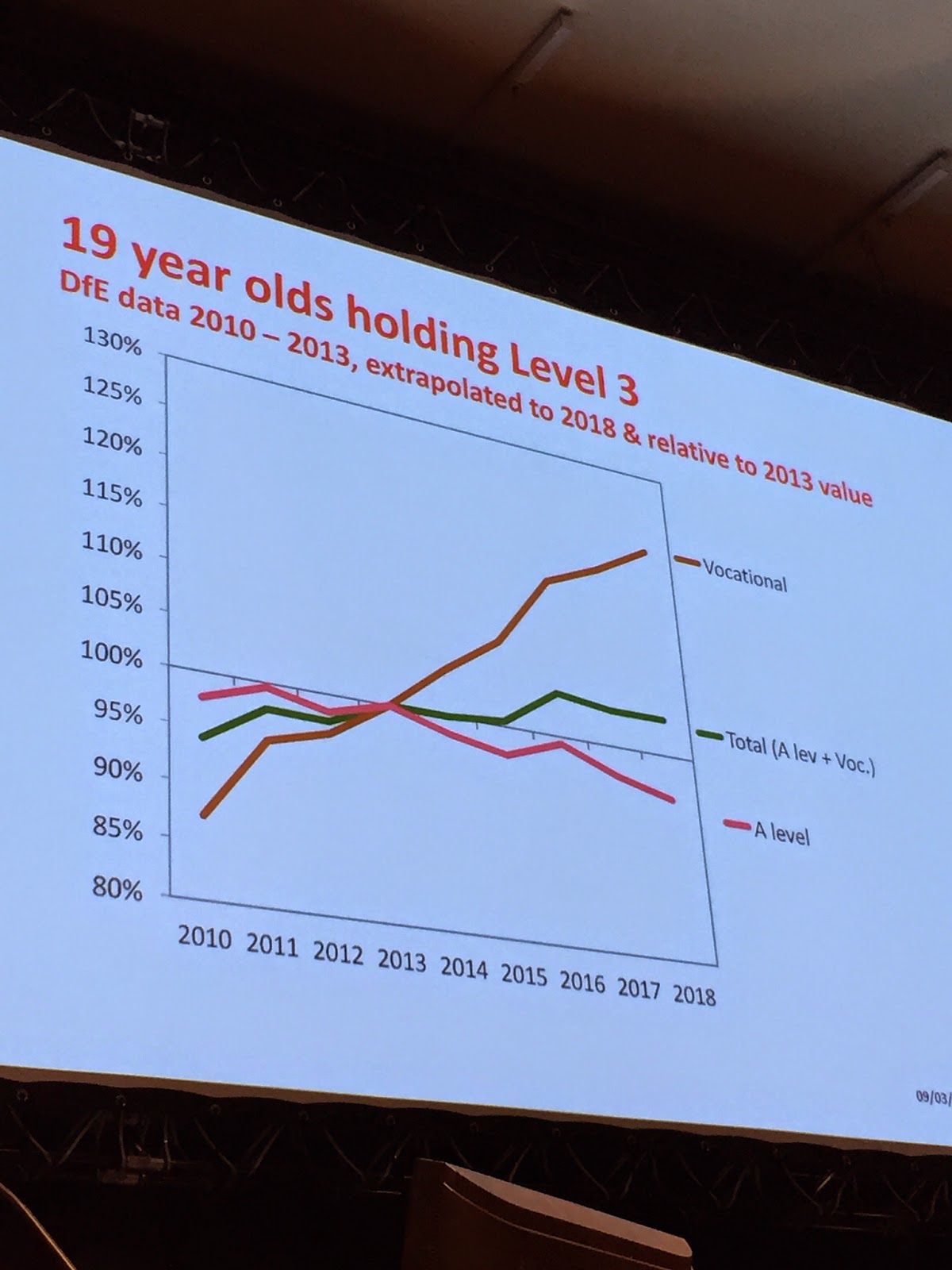
No of BTecs going up. Now 100,000 people coming into HE with BTEcs.
Demographics, no of 18 year olds dropping. No of vocational qualifications growing.
Big challenge for selecting organisations.
UCAS IT function is complex!
Moving to SOA.
Building a profile based on a learners journey.
Thought they would spend 50% on core services, and 50% on change
Closer to 90:10. Transformation plans slipping away. Every year something would go wrong with legacy systems.
So, proposed digital acceleration
Increase investment in short term. Every pound spent on legacy system is a pound wasted,
Need to increase velocity of change.
Used to traditional approach to project management - waterfall, prince2 but this eant working.
So, moved to Agile. Embrace change, quality comes from feedback. Adapt as you go along. Collect information as you learn. Deliver working software as early as possible and as often as possible with feedback loop built in.
Good diagram of the benegits of Agile:

At "Wagile" at the moment, bit waterfall, but agile.
Gradually rolling it out.
Keeping an eye for what they want at the end
It's all about culture and mindset, not IT.
Great opening keynote.
- Posted using BlogPress from my iPad
Opening keynote was from Mary Curnock Cook, Chief Executive of UCAS. Here's some notes from her talk.
The UCAS mission is to inspire and facilitate progression in education through information and admissions services,
It's a charity, with a commercial subsidiary, operating in Cheltenhem with 450 employees. As a charity, it is regulated. Have to report on the public benefit they deliver. So, they have to help learners progress etc.Not just about admissions.
They have no government funding.
Serve 163 universities, 167 university colleges and colleges offering HE. c700 other HE providers
In 1962, less than 100,000 applicants. Now 700,000. . Much more diverse now.
In 62, nearly all men. Now more women then men, also worrying.
First shared service, argueably the most successful.
Business processes almost the same now as 62.
UCAS one of busiest web sites in country.
Now offer advice for post GCSE, not just HE. Advice on apprenticeships etc.
Trying to get good advice to kids earlier.
Big social media presence
On just one day in August....
55m UCAS.com views
5m exam results
239 log ins per second
18000 phone call
5.5pvs
1.25m log ins to Track
Thanks for the cloud. No way they could afford to gear up server capacity for this short time of capacity.
Key drivers of change in applications is not fees
Changing qualification landscape.
No of BTecs going up. Now 100,000 people coming into HE with BTEcs.
Demographics, no of 18 year olds dropping. No of vocational qualifications growing.
Big challenge for selecting organisations.
UCAS IT function is complex!
Moving to SOA.
Building a profile based on a learners journey.
Thought they would spend 50% on core services, and 50% on change
Closer to 90:10. Transformation plans slipping away. Every year something would go wrong with legacy systems.
So, proposed digital acceleration
Increase investment in short term. Every pound spent on legacy system is a pound wasted,
Need to increase velocity of change.
Used to traditional approach to project management - waterfall, prince2 but this eant working.
So, moved to Agile. Embrace change, quality comes from feedback. Adapt as you go along. Collect information as you learn. Deliver working software as early as possible and as often as possible with feedback loop built in.
Good diagram of the benegits of Agile:
At "Wagile" at the moment, bit waterfall, but agile.
Gradually rolling it out.
Keeping an eye for what they want at the end
It's all about culture and mindset, not IT.
Great opening keynote.
- Posted using BlogPress from my iPad
Tuesday, 17 March 2015
UCISA 15 is here
Well, for the past year I've been chairing the Organising Committee for the Annual UCISA Conference - and now it's finally here! I'm in Edinburgh, at the conference centre, waiting for it to start. The programme has come together really well, as far as I know all the speakers are turning up, the social events and the exhibition are organised and well under the control of the UCISA office.
Most of the plenary keynotes, including one from me and Tim Kidd from JISC tomorrow, will be live streamed here. Can't wait for it to start!

Most of the plenary keynotes, including one from me and Tim Kidd from JISC tomorrow, will be live streamed here. Can't wait for it to start!
Subscribe to:
Posts (Atom)